Showing posts with label train. Show all posts

Wednesday, November 29, 2017

New Lens Wide Angle Wednesday!!

Recently, I was able to obtain the Canon EF 11-24mm f/4L USM lens. I haven't used it too much for personal photos, have used it to capture a couple of my company's events we lit. So the shots I have taken are mostly of my commute. This post is my initial feedback on this lens.

LIRR M7 Interior shot at Penn Station

The lens is big, the front glass element protrudes very far, almost to the point of pushing past the built in lens hood. The lens cap is very large because of that fact, and you cannot mount normal screw filters to this lens. There is a filter slot in the back, and I believe Lee makes an adapter set, but I haven't tried those yet.

In addition to the size, it also is one of the heaviest lenses I have handled. It weighs about 2.5 pounds, which doesn't seem like much until you start lugging it around, either on the camera or in the camera bag. 

Downtown Bound M Train from Queens

But the sharpness of this lens! So far I am finding it to be sharp throughout the frame. And there is also minimal flare from light sources hitting the lens, unlike the fisheye lens and the Tokina 11-16mm f/2.8 lens I used before. 

I need to spend some more time with this lens. It is wide though!! 11mm on a full frame body is amazing! So far I am loving it, I just need to build up my strength so I can bring it everywhere. 

Seagram's Building in Manhattan at night

Wednesday, March 15, 2017

Stella!

"Neither snow nor rain nor heat nor gloom of night stays these couriers from the swift completion of their appointed rounds"
Canon 5D Mark III, EF40mm f/2.8, f/8, 1/500sec, 1600ISO, 40mm

Winter storm Stella hit NYC yesterday. I had to go to work in the afternoon. The train was deserted. Manhattan was empty of cars and people, very few people were out. I grabbed my camera and threw the 40mm pancake lens on with the intention of capturing some snowy images on my commute. 


Long Island Rail Road M7 pulling in
Canon 5D Mark III, EF40mm f/2.8, f/10, 1/320sec, 640ISO, 40mm
I didn't take my camera out of the bag until I got to the train station. The snow was falling, it was cold and breezy. My camera worked fine, I tried to keep it dry, but it did get a little wet. Putting it in my bag or jacket pocket after use caused it to fog up the viewfinder a bit, so some of the photos I was shooting were basically done blind, hoping that the composition and focused was spot on, and hoping the exposure wasn't blown out or too dark. 


Older style MTA Logo on the rear door of the F-350
Canon 5D Mark III, EF40mm f/2.8, f/8, 1/320sec, 1600ISO, 40mm


The Joyce Theater
Canon 5D Mark III, EF40mm f/2.8, f/8, 1/640sec, 1600ISO, 40mm


Graffiti and Greek Food
Canon 5D Mark III, EF40mm f/2.8, f/8, 1/320sec, 1600ISO, 40mm


Clearing the streets
Canon 5D Mark III, EF40mm f/2.8, f/8, 1/500sec, 1600ISO, 40mm
Penn station was empty for a weekday rush hour time. I wish it was always so empty. 


Tuesday at 5:36p, usually very limited space to walk around the waiting people in the area
Canon 5D Mark III, EF40mm f/2.8, f/5.6, 1/100sec, 320ISO, 40mm
When I got off the train at my station, the lens got some condensation on it, and I failed to notice until I reviewed the photograph of the station and train.  Oops.


condensation on the lens
Canon 5D Mark III, EF40mm f/2.8, f/5.6, 1/160sec, 1250ISO, 40mm
My wife had sent me a text stating that the lights were flickering in the house and half the wall circuits around the house weren't working. And when I got close to home, I noticed a burning electrical smell, with lots of FDNY trucks present. Black smoke was pouring out of a subway grate (not for a subway though). FDNY left, then ConEd showed up with their emergency service vehicles. A manhole cover near the grating popped a short time later, I hear it as I was trying to shovel the sidewalk and driveway. Flames started shooting up, and a couple more pops. We ended up loosing all power a little while later, but ConEd was able to get it restored around 3am. 


Smoking!
Canon 5D Mark III, EF40mm f/2.8, f/8, 1/100sec, 2000ISO, 40mm


Friday, October 17, 2014

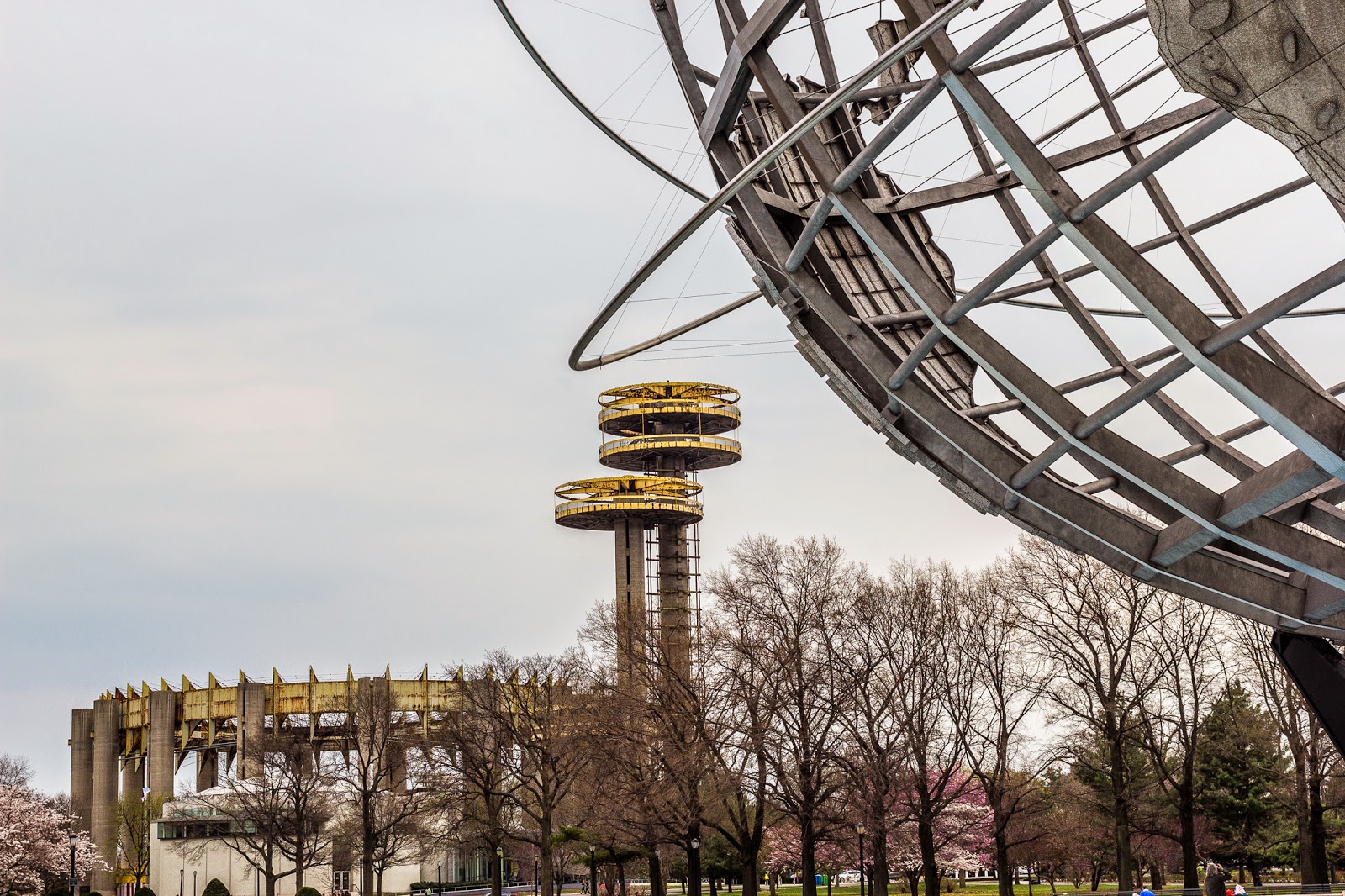
New York State Pavilion Open Gate on Opening Day 50th Anniversary

Springtime in Flushing Meadows-Corona Park
Canon 60D, EF40mm f/2.8, f/8, 1/500sec, 100ISO, 40mm

Wednesday I posted photos from April 22nd of this year through the wide angle lens (World's Fair Wide Angle Wednesday). Today, I am adding some of the photos that were captured through my shorty forty (EF 40mm f/2.8 STM), and one from an old zoom lens I inherited (EF 75-300mm f/4-5.6 USM). 

There is a Long Island Railroad station that serves Flushing-Meadows. It opened for the first World's Fair in 1939. When I first moved to Queens, it was the Shea Stadium stop, but now it is called Mets-Willets Point. This station is only operational during the US Open, and during Mets home games. Since the fall, the LIRR has been utilizing tracks 3 through 4 as a parking lot for some of the trains during the afternoons. 

Red Bird in the wild
Canon 60D, EF40mm f/2.8, f/10, 1/500sec, 100ISO, 40mm

I spotted a Red Bird (9343) in the Corona Yard, the storage facility for the MTA's New York City Transit's 7 Trains. Though referred to as Red Birds, the R33 World's Fair cars were originally light turquoise and white. This car was delivered by the St. Louis Car Company in October of 1963. These cars were taken out of revenue service in November of 2003, so I did get a chance to ride the Red Birds after I moved to NYC. Some of them now serve as artificial reefs down the Atlantic Cost, a few are being preserved, and some, such as this one, serve as work cars.

Also visible in that photograph are the USTA Billie Jean King National Tennis Center, where the US Open is held, and the Unisphere, and the Observation Towers of the New York State Pavilion. The larger stadium is Arthur Ashe Stadium, which is the world's largest tennis specific stadium. It opened in 1997. The smaller stadium is Louis Armstrong Stadium, named after the jazz musician who lived close by in Corona, Queens. It served as the main stadium from 1978 until 1997 when Arthur Ashe Stadium opened.

Silver, silver, black and yellow
Canon 60D, EF40mm f/2.8, f/8, 1/200sec, 100ISO, 40mm
I walked further south making my way to the Pavilion and took a quick shot of a work train at rest. It is never a good sign when you see one of these barreling through a station at night, so I prefer to observe a work train in these conditions.

Unisphere looking North towards Arthur Ashe Stadium in Springtime
Canon 60D, EF40mm f/2.8, f/9, 1/250sec, 125ISO, 40mm
The Unisphere is one of the most iconic images of Queens, if not New York City as well. It was built on top of the Perisphere's foundation from the previous World's Fair, and was a gift from United States Steel Corporation. It features three rings, one to represent the orbit of Yuri Gagarin, the first man in space (Russian Cosmonaut), John Glenn, the first American in space, and Telstar, the first active communications satellite. 

Dry Unisphere and Queens Museum
Canon 60D, EF40mm f/2.8, f/8, 1/400sec, 320ISO, 40mm

The Unisphere is located just outside of the Queens Museum, where I spent some of the time waiting. The thing is massive! The people in the above photograph give you a sense of the scale. It is 140' tall, and weighs 700,000lbs with a 100ton inverted tripod. 

LGA, Riker's Island, Flushing Meadows-Corona Park, College Point from the "air"
Canon 60D, EF40mm f/2.8, f/3.5, 1/80sec, 1600ISO, 40mm
As I wrote previously, the Panorama of the City of New York is where I spent some of my time waiting. The following are some more detail shots, since they weren't taken with the wide angle lens. 

Flushing Meadows-Corona Park from the South looking North
Canon 60D, EF75-300mm f/4-5.6 USM, f/4.5, 1/320sec, 6400ISO, 40mm

When the Fair closed, the Panorama remained open to the public, and the map was updated regularly until 1970. It wasn't updated from 1970 until 1992, when 60,000 structures were added. Beginning in 2009, the Museum decided to try to keep it updated more regularly. People and organizations can donate money to adopt an accurate scale model of their building. The first updated model was the Mets' CitiField, which replaced Shea Stadium in 2009.

Downtown Manhattan
Canon 60D, EF40mm f/2.8, f/3.5, 1/125sec, 1600ISO, 40mm

One of the buildings that no longer exist in the skyline, the World Trade Center's Twin Towers, still remain on the map. They will be replaced when construction at the site is finished and the new buildings are complete, rather than a hole in the map.

Waiting...
Canon 60D, EF40mm f/2.8, f/5, 1/320sec, 125ISO, 40mm

After heading back to the gates of the Tent of Tomorrow, I waited outside for our number to be called. Hardhats were required once inside. I noticed they had placed blue decorative balls ontop of the rods just above the entrance, as it looked 50 years prior. And a flag was hung there as well.

Towers through the Tent
Canon 60D, EF40mm f/2.8, f/8, 1/1000sec, 125ISO, 40mm

I finally made it inside! We were told we had 10 minutes, so I tried to make the most of it, capturing some images with my shorty forty and switching to the wide angle lens. This was a once in a lifetime opportunity for me.

West Entrance with Texaco
Canon 60D, EF40mm f/2.8, f/8, 1/250sec, 125ISO, 40mm

They had restored some of the signage, such as the Texaco sign.

 
Planters
Canon 60D, EF40mm f/2.8, f/8, 1/250sec, 125ISO, 40mm

And the Restaurant sign as well...

Stitched Together
Canon 60D, EF40mm f/2.8, f/8, 1/250sec, 125ISO, 40mm

I took several photos and used Microsoft's Image Composite Editor to create this large image above. 15 images were combined to create the final product.

My time was up, I left and headed back to the LIRR to head home to Northeastern Queens. As I passed the Unisphere, I turned around and captured one final image of the Pavilion. One final image that day, as I have returned multiple times since April to the park and always seem to photograph it. 

Remnants of the World's Fair in Spring
Canon 60D, EF40mm f/2.8, f/8, 1/400sec, 320ISO, 40mm


Monday, July 28, 2014

Shorty Forty

One of the things that every photographer suffers from at some point is gear lust. You want to buy every piece of gear available, more lenses, perhaps a better body, lots of accessories. I am no different. 
 
Underground
Canon EOS Rebel T3i, EF50mm f/1.8, f/1.8, 1/60s, 400ISO, 50mm

My first photography purchase was actually the Nifty Fifty, the Canon EF 50mm f/1.8 lens. I used this lens with the company's Canon Rebel T2i, before I had purchased my first body, the Rebel T3i. It was great, I could shoot wide open (aperture at f/1.8) to get that oh so desirable bokeh. It is a cheap lens, I picked it for $109 before tax.
 
Fallen Wood
Canon EOS Rebel T3i, EF50mm f/1.8, f/2.8, 1/250s, 100ISO, 50mm

The Nifty Fifty, and the Shorty Forty, are both prime lenses, meaning that they have a fixed focal length. Prime lenses are great photographers of all skill levels. They usually have faster apertures than a zoom lens, lighter, and cheaper as well. One of the things that a fixed focal length also forces a new photographer to do is think about composition. Zoom lenses allow you to be lazy, all you have to do is zoom in or out from your same vantage point. A prime lens forces you to zoom with your feet. If you want to get more of the scene in the frame, you have to physically walk back, if you want to fill the frame with your subject, you have to get closer. Sometimes, you are not able to physically get closer or further, so you will have to change your framing to compensate, look at the scene in a new way. 
 
From the Hip
Canon EOS Rebel T3i, EF50mm f/1.8, f/1.8, 1/60s, 100ISO, 50mm

I believe on of my best investements was a prime lens. Of course, when I first obtained my Nifty Fifty, I was shooting everything wide open, which at f/1.8, allows more light in, allowing for faster shutter speeds, but will create a shallow depth of field, so the part of the image in focus was minimal. When you move from a kit lens that only opens to f/3.5, you can't help yourself.

When my Rebel T3i was stolen, I had the Nifty Fifty mounted. I was glad that it was the cheap lens, though I was still bummed about the whole camera gear being stolen, I tried to look at the bright side of things and realize it could have been worse. The Rebel was replaced by a Canon 60D, so my primary lens was the Canon EF-S 18-135mm f/3.5-5.6 kit lens that was purchased with the now stolen Rebel. After Christmas about 8 months later, I had some gift cards, and decided I wanted a prime lens again.

Having owned the Nifty Fifty, I knew it was cheap, but there were somethings about it I didn't like. It felt cheap, the AF motor was noisy. My budget was low, as I only had a couple gift cards, so the EF 50mm f/1.4 was too expensive as were a few other primes.

Canon had released a pancake lens, called that because of how flat it was, and my interest was piqued.The pancake lens, the Shorty Forty, or EF 40mm f/2.8, was a little wider than the 50mm, but since I shoot on a crop body, I thought that would be fine. Many sites have said that 50mm on a full frame camera is about the equivalent of what your eye sees. On a Canon crop body, the 50mm is about 80mm, while the 40mm is about 64mm.

I ended up purchasing the Shorty Forty. Though the max aperture is f/2.8 as opposed to f/1.8, you end up stopping down the aperture anyways, so that wasn't too big of and issue. Reading reviews, time and time again they discussed how sharp it was for the price, even wide open. I decided to purchase it and am very happy I did.
 
Sunset over Manhattan from Queens
Canon 60D, EF40mm f/2.8, f/8, 1/1000s, 100ISO, 40mm

One of the things I like most about the Shorty Forty is how small it is. I can leave it mounted to my 60D, and the camera isn't large or cumbersome to carry around when I go out with my family, or even if I just throw it in my bag on the way to work. I found myself wanting to take my camera more places. When shooting for work, I sometimes would just throw the Shorty Forty in my pocket while the camera body will have the wide angle attached, and it allows me to capture some details shots, as the minimum focusing distance is pretty close for a non-macro lens. 
Signs of Spring
Canon 60D, EF40mm f/2.8, f/8, 1/125s, 160ISO, 40mm

There is one thing that I don't like about the lens. The lens focusing mechanics only work when the camera is on. This means that if you leave the lens protruding, though it doesn't that much, you can't manual focus it back when the camera is off. This also means that the lens can't focus when used with cheap macro extension tubes since those tubes don't have electrical contacts. Other than that though, this lens shines! 
Auburndale Snow
Canon 60D, EF40mm f/2.8, f/8, 1/50s, 640ISO, 40mm

I highly recommend this to anyone looking for their first foray outside of the kit lens their camera came with when purchased. It probably is attached to my camera more than any other lens at this point.

Friday, June 13, 2014

Vanishing Points

Canon 60D, EF 40mm f/2.8 STM, f/4, 1/100s, 3200ISO, 40mm


I love a good vanishing point. Forced Perspective and all that jazz. Living in NYC, I am constantly seeing them, from the two tracks leading into and out of my railroad station, to the grid in Manhattan. Part of my brain loves the symmetry of a vanishing point photograph. 

Looking Up for Grace
Canon 60D, EF-S 18-135mm f/3.5-5.6, f/16, 1/6400s, 160ISO, 18mm
Canon 60D, EF-S 18-135mm f/3.5-5.6, f/13, 1/40s, 160ISO, 36mm
Into the Mouth of Madness
Canon 60D, EF 40mm f/2.8 STM, f/8, 1/125s, 640ISO, 40mm


Monday, June 2, 2014

First Post

In the beginning....

Zoom

I have always had a spark for photography.  As a kid, my mother owned a Minolta SLR that would always join us on family vacations.  As I grew older, she allowed me to play with it, maybe fire off a couple of shots.  I fondly remember after returning to our home after vacation, the rolls of film would be dropped off for processing.  A day or two later, we would retrieve the envelop of photographs, and all of us would enjoy reliving the great times we had just experienced on vacation.

Finally, sometime in high school, I was given my mother's old SLR.  Life soon got in the way, and by the time I had departed home for college, the SLR had been left behind.  I didn't take as many photos in college as I should have, but I was a poor theatre student whom couldn't afford film and development.  Why I never thought to take a photography course, I don't know, especially since the dark rooms were in the basement of the Theatre Building, if memory serves me right.

The next big step after college was a move to Brooklyn, NY.  The year was 2001.  I had a film point and shoot, and used it occasionally in the first 6-9 months of living in New York City.  I had seen digital cameras around, and my interest was peaked.  

My first digital camera was a Fujifilm point and shoot that was larger than a normal point and shoot.  I purchased it from ubid.com in the spring of 2002, and started taking it everywhere.  My girlfriend, who would become my wife several years later, was performing on a cruise ship, I was freelancing, so somedays I would just go into the city and start taking pictures of everything.  I took a cruise to see what my girlfriend's world at sea was like, and must have taken several hundred pictures of the food buffet.


"Your first 10,000 photographs are your worst" 
Henri Cartier-Bresson

Most photographers are familiar with the above quote from Henri Cartier-Bresson.  I believe it applies to anything one strives to do.  Outliers: The Story of Success by Malcolm Gladwell also supports this theory.  Needless to say, The first 10,000 of my photographs were bad.  But they helped me understand composition.  I also started to play with the Program Mode instead of fully auto, but still wasn't proficient at using a camera.

My next two cameras were little Sony point and shoot cameras, better sensors, larger files, smaller camera size.  I would take my camera with me on vacation, when traveling for work, and site seeing in the city when people came to see us.  During this time, I also was able to use a Canon Rebel that was available at my job.  I started honing my skills with a dSLR, started remembering how to use a camera on manual, what the aperture did, how it affects the final image.  Still though, I was shooting JPEGs, allowing the camera to make the processing decisions.  I also didn't delete many of the photos that should have never been imported. 

My wife and I were blessed with a baby girl in August of 2011.  Before that time, my most patient subject were our two chihuahuas, though even they would roll their eyes at me when I would bust out the camera.  Since my wife's family lives in Texas, and mine is still in Arizona, ever Christmas we would fly to one state or the other to spend the holidays with family.  Our baby's first Christmas was spent in Queens, and with the money that we normally would spend on flights, I spent on my first dSLR, a Canon Rebel T3i with the EF-S 18-135mm f/3.5-5.6 kit lens.

I chose Canon for a couple of reasons.  My job had a Canon, so I was already familiar with the layout and menus.  My mother and friend own Canon cameras, so I figured maybe eventually we could borrow each other's gear.  I chose the kit lens I did because that is the lens my mother had purchased with her 50D, and I thought it was better than the EF-S 18-55mm kit lens that I had access to at my job.  I am pleased with my decision, though it isn't on my camera as much these days, it still is used a lot.

With the new baby, I had a new subject.  I shot so many photos of her, and started keeping all of them even if they were a little out of focus.  But that practice would end soon, as I discovered the beauty of shooting in RAW, and those larger file sizes started adding up quickly.  The first 10,000 photographs with the new dSLR were marginally better than the point and shoots I had, but I would still consider most of them to be bad.

I struggled to get what my eye and mind saw onto the memory card.  I started to understand a little more that aperture not only allowed more light in when opened up (smaller number), but also controlled depth of field.  Focal length and its relationship to shutter speed was something else I started to learn.  The histogram began to be useful to me as I understood dynamic range and its impact on my final image.

I read everything I could get my eyes on, trying to absorb everything I could that had anything to do with photography.  Practice, practice, practice.  I started to get gear lust, thought that if I got this or that, my images would be better.  But with having a baby around, we didn't have disposable income, so I would just daydream about a fullframe camera, or some L glass.  

I was also trying to find my style.  I loved taking photos of New York City, and of the landscapes on our travels.  I started getting interested in HDR.  My early HDR work is overly processed.  Lightroom 3 and Photomatrix was added to my software arsenal, though I wasn't entirely sure what I was doing with each slider.  

The camera started going to work with me, I captured a couple of our events.  One of these days, I brought it to capture an event we had at the New York Stock Exchange, firing off brackets to create some HDR images.  Then, switched to my EF 50mm f/1.8 lens and went to the American Museum of Natural History for a client meeting.  Shot some at the Museum, some on the subway on the way back to the office.  That would be the last time I used that camera and lens, as my camera would be stolen off of my desk while I was in the back of the office.  But it wouldn't be the last of the images I would create.

Last shot
The first shot in this post is from August 3rd of 2012. One of my first attempts at a long exposure to get the light trails, I lucked out with the LIRR crossing the Clearview Expressway. Canon 60D EF-S18-135mm f/3.5-5.6 IS

Aperture: f/14.0
Focal Length: 18.0mm
Shutter Speed: 10s
ISO: 100

The last shot in this post is from April 1st, 2012. Canon Rebel T3i EF 50mm f/1.8

Aperture: f/2.0
Focal Length: 50mm
Shutter Speed: 1/60s
ISO: 400